This was a month in which I read not widely but well.
I ended May with my reading mojo restored but at times I thought I’d never pick up a book again.
I have a very low fear threshold. Enid Blyton’s “Five and the Mystery Train” scared me so much as a child I couldn’t even have the book facing upwards. This book looked as though it might have the same impact. Lighthouses are fascinating, aren’t they? Out of their element, beacons of mystery made of huge chunks of stone yet constantly vulnerable. And before they were automated, men (it was usually, not always) lived in peril and isolation to offer safety to others. This mystery bowls along with all the necessary ingredients and the added flavour of backstory, background and the women left on shore, as isolated and unsafe as their menfolk.

This is a frightening book, but not in the ways I expected. As so often the case with a murder mystery, the scariest thing is what we carry with us.

This was a delight from start to finish. Warm, full of good food, and with a central character (perhaps two) finding their way out of the darkness. Like all families, there are a couple of complete horrors and much need for forgiveness and tolerance. This family has that patina of perfection and glamour that can fool us all, but how do they cope when someone steps off the path? On his wedding day. It swept me into a semi-familiar world – a family like many others, but living a unique life. You probably wouldn’t want to visit them, but you’d wish them well.
Around mid-May, I started to struggle with my reading. I lost the power to concentrate, plagued with a nasty attack of monkey brain. You know, that chattering, restless feeling brought on by work, or stress, or just…life. This book was on order at my local library, so I just had to read it and return it, and I’m very glad I did.
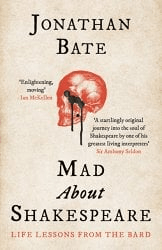
Jonathan Bate is a delightful person. Kind, funny and with the gift that the truly brilliant have. He doesn’t – as some lesser scholars do – make the listener or reader feel stupid in the face of his brilliance, rather he brings everyone along with him. I saw him talk about this book at a bookshop event and most people had a tear in their eye when he described Edward Thomas reading (from Antony and Cleopatra) to his wife, the night before returning to the trenches. It was no less moving and profound on the page.
Bate talks about his amazing education, the close reading insisted upon by good teachers, and the confidence which grew in the class. As a teenager, Bate spent hours roaming the nearby grounds of Knole, one of the great British houses, and his love of history and landscape flows from the page. As you’d expect though, this is mostly about Shakespeare. I was thrilled to know some of my favourite productions were also his, and he’s very clear-eyed about actors and directors. He brings us unsparingly into the most painful times in his life and shows us how words can heal, sustain and inspire.
After being immersed in this I thought my reading troubles were over, but no, it wasn’t so. I was making a slow recovery from monkey brain, only to be struck down with a nasty dose of booksteria. You’ve never had it? You are lucky, but also missing out. Booksteria is that feeling you get when you survey the books you have – charity shop buys, gifts, library books and all the stuff you’ve just accumulated – and can’t decide which one to read next. I held my hands over them like a water-diviner, hoping the fountain of inspiration would make itself known. I picked them up. I put them down.
I got through the preface to a biography, then promptly lost all interest in the subject.
I started a novel, then a nature book. I spoke to the books. They didn’t reply.
Books, books everywhere, and nothing to read.
Finally, I opened this book and found it is made of many individual paragraphs, some just a few sentences long. That could work, I thought. If I couldn’t read a whole book, I could at least manage a paragraph. And what paragraphs! Each one so complete, so satisfying. Each one a cell, containing all the DNA of the novel. The story unfolds in moments, like life. The central character struggles and – as we know – worse is to come. The novel is set in 2016, in New York. There’s sadness, melancholy, love and anxiety. The central character is a librarian and she knows where the truth is shelved. All I could register was that I was reading, reading, reading, and eventually, having read.

 Suzy D Harris